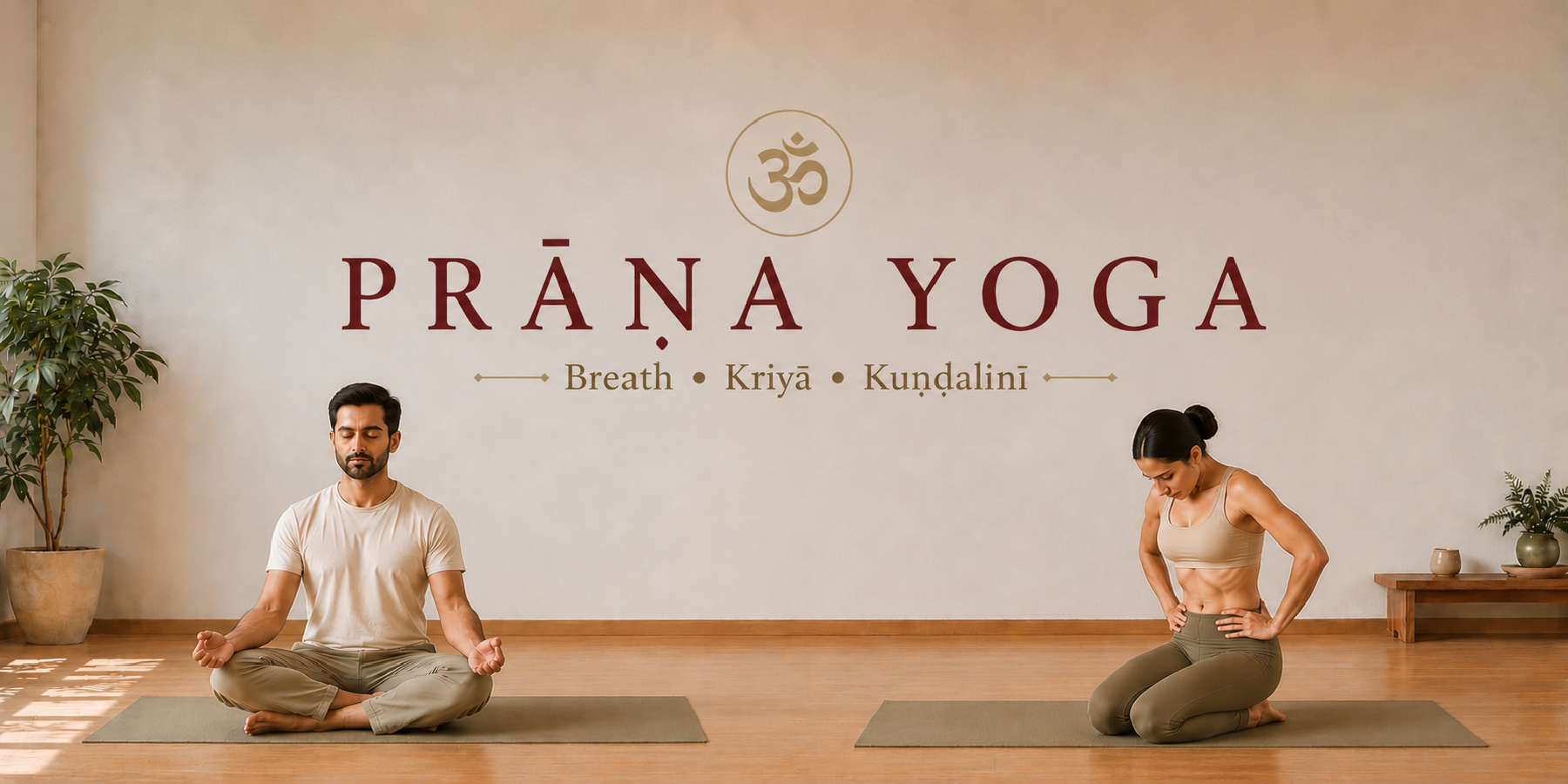
Prāṇa Yoga
Breath • Kriyā • Kuṇḍalinī
Breath • Kriyā • Kuṇḍalinī
Prāṇa Yoga is the second anga of Trianga Yoga, concerned with the cultivation, refinement, and direction of prāna—the vital force that animates the body and shapes the movement of the mind. While Kāya Yoga works primarily through the body, Prāṇa Yoga enters the subtler field of breath, energy, nāḍī, vāyu, cakra, and kundalinī.
Rooted in the principles of Haṭha Yoga and informed by the philosophical insights of Yoga, Tantra, and Vedānta, Prāṇa Yoga approaches breath and energy not merely as techniques for relaxation, but as doorways into inner transformation. Through prānāyāma, mudrā, bandha, cakra kriyā, and kundalinī kriyā, the practitioner learns to stabilise the body, regulate the nervous system, refine awareness, and prepare the subtle body for deeper meditative absorption.

Why Prāṇa Yoga?
The ultimate objective of Prāṇa Yoga is the awakening of kundalini through the traditional path of Hatha Yoga. While Kāya Yoga cultivates strength, stability, and functional movement within the physical body, the deeper dimensions of yoga require the refinement of prāna, the vital force that underlies every physiological, psychological, and spiritual process. Breath is the most accessible expression of prāna, and through its conscious regulation, the practitioner gradually learns to influence the nervous system, steady the fluctuations of the mind, and prepare the subtle body for higher states of practice.
The ancient yogic traditions consistently recognise that the quality of the mind is intimately connected to the movement of prāna. An agitated breath reflects an agitated mind, while a calm and regulated breath creates the conditions for concentration, meditation, and inner stillness. As prāna becomes balanced and directed through practices such as prānāyāma, mudrā, bandha, and kriyā, the practitioner begins to awaken dormant psychoenergetic potential. In this way, kundalini is not viewed as a dramatic or isolated phenomenon, but as the natural culmination of sustained Hatha Yoga practice. By harmonising breath, prāna, and awareness, it creates the foundation upon which deeper meditation, mantra, devotion, and spiritual insight can naturally unfold.
Is Prāṇa Yoga the Same as Kundalini Yoga?
The short answer is yes and no.
The objective of Prāṇa Yoga is the awakening of kundalini through the traditional methods of Hatha Yoga. In this sense, it is indeed a form of kundalini practice. However, it differs from many modern systems that are presented under the name Kundalini Yoga.
Traditionally, there was no separate type of yoga known simply as Kundalini Yoga. Kundalini was understood as the latent spiritual potential within every individual, and its awakening was recognised as an underlying aim of several yogic traditions, including Hatha Yoga, Mantra Yoga, Tantra, and the meditative disciplines of Classical Yoga. Rather than constituting an independent path, kundalini awakening was approached through practices such as prānāyāma, mudrā, bandha, mantra, meditation, and disciplined spiritual living.
The expression Kundalini Yoga became widely known only during the twentieth century. While several respected teachers used the term to describe their own systems of practice, these represent particular interpretations rather than the traditional understanding of kundalini within the broader yogic tradition.
Prāṇa Yoga therefore presents kundalini within its classical context. It approaches kundalini awakening as the natural culmination of a systematic Hatha Yoga practice, supported by the study of traditional philosophy, the refinement of prāna, and the gradual preparation of both body and mind. Rather than pursuing extraordinary experiences, the emphasis is placed on steady practice, discernment, and inner transformation.
Prānāyāma, Mudrās & Bandhas
Prānāyāma forms the foundation of Prāṇa Yoga. More than a collection of breathing exercises, it is the systematic science of cultivating, refining, and directing prāna within the body. Through the conscious regulation of inhalation, exhalation, and retention, the practitioner gradually develops greater vitality, mental clarity, emotional stability, and energetic awareness. As the breath becomes steady, so too does the movement of prāna, creating the inner conditions necessary for concentration, meditation, and the deeper stages of yoga. Traditional prānāyāma practices also help purify the nāḍī system, harmonise the vāyus, and prepare the subtle body for kundalini awakening.
Mudrās and Bandhas further deepen this process by conserving, directing, and intensifying the flow of prāna. Mudrās act as psychoenergetic gestures or seals that influence both the body and the mind, guiding energy towards specific channels and states of awareness. Bandhas, often described as energetic locks, regulate internal pressures and redirect the movement of prāna within the body. When integrated with prānāyāma, they transform the breath from a physiological process into a profound instrument of inner awakening.
In Prāṇa Yoga, these practices are approached progressively and within the broader framework of Hatha Yoga. Rather than being isolated techniques or pursued for extraordinary experiences, they are cultivated with patience, precision, and understanding. Together, prānāyāma, mudrās, and bandhas establish the energetic foundation upon which the safe and gradual awakening of kundalini naturally unfolds.
Chakra & Kundalini Kriyās
A distinctive feature of Prāṇa Yoga is the systematic practice of chakra kriyās and kundalini kriyās. These practices integrate breath regulation, concentration, visualization, mantra, and subtle energetic techniques to refine the movement of prāna and cultivate deeper states of awareness. Rather than being isolated exercises, they build naturally upon the foundation established through prānāyāma, mudrās, and bandhas.
Chakra Kriyās are designed to cultivate awareness of the principal psychoenergetic centres described in the Hatha Yoga and Tantric traditions. Through sustained attention and carefully structured practices, the practitioner gradually develops greater sensitivity to the flow of prāna, harmonises the energetic functions associated with the chakras, and prepares the subtle body for deeper yogic experience. The emphasis is not on imagination or visual spectacle, but on developing refined awareness through disciplined practice.
Kundalini Kriyās build upon this preparation by employing traditional methods intended to facilitate the gradual awakening and upward movement of kundalini through the central channel. These practices are approached with patience and discernment, recognising that kundalini awakening is not an isolated event but the culmination of a balanced and integrated yogic discipline. Within Prāṇa Yoga, the emphasis remains on steady inner transformation rather than the pursuit of extraordinary experiences, ensuring that practice is guided by preparation, stability, and understanding.
Chitta Shuddhi: Psychological Refinement through Prāṇa Yoga
Prāṇa Yoga recognises the intimate relationship between breath, prāna, and the mind. The yogic tradition maintains that where prāna moves, the mind follows; conversely, the state of the mind is reflected in the rhythm and quality of the breath. An agitated mind gives rise to an agitated breath, while a calm and regulated breath creates the conditions for mental clarity, emotional balance, and inner stillness. By consciously refining the movement of prāna, the practitioner gradually learns to influence not only the body but also the patterns of thought, emotion, and perception.
The purpose of these practices extends beyond the cultivation of energy. Their deeper aim is chitta shuddhi—the gradual purification and refinement of the mind. As the fluctuations of the mind become quieter, habitual reactions begin to weaken, emotional disturbances lose their intensity, and greater clarity, steadiness, and discernment naturally emerge. This psychological refinement is not achieved through suppression or control, but through the harmonious regulation of prāna and the cultivation of sustained awareness.
Within Trianga Yoga, Prāṇa Yoga therefore serves as the bridge between the physical discipline of Kāya Yoga and the devotional and contemplative practices of Mano-Yoga. By purifying both the subtle body and the mind, it prepares the practitioner for deeper meditation, mantra, devotion, and ultimately the direct recognition of one’s true nature.
Philosophical Exploration in Prāṇa Yoga
Prāṇa Yoga is founded upon the understanding that meaningful practice arises from meaningful knowledge. While prānāyāma, mudrās, bandhas, and kriyās cultivate direct experience, philosophy provides the framework through which that experience is understood, interpreted, and integrated. The study component of Prāṇa Yoga therefore complements practice by exploring the principles that underlie the traditional science of Hatha Yoga.
The curriculum begins with the subtle anatomy described in the yogic and tantric traditions, including the concepts of nāḍīs, vāyus, chakras, and kundalini. These models provide a deeper understanding of how prāna is cultivated, directed, and transformed through yogic practice, offering a framework that extends beyond the physical body into the subtler dimensions of human experience.
This exploration is further enriched through the study of Sāmkhya, Vedānta, the Yoga Sūtra, the Bhagavad Gītā, and Tantra, particularly the non-dual tradition of Kashmir Shaivism. Together, these philosophical traditions illuminate the nature of consciousness, the relationship between body, mind, and spirit, and the transformative purpose of yoga. Rather than presenting philosophy as an abstract intellectual pursuit, Prāṇa Yoga approaches it as a practical guide that informs, deepens, and gives direction to every aspect of yogic practice.
Practice
The practical disciplines of Prāṇa Yoga are approached progressively, with each practice building upon the previous one to cultivate, refine, and direct prāna. Together, these methods prepare the practitioner for deeper states of concentration, meditation, and the gradual awakening of kundalini.
- Prānāyāma – Traditional breathing practices for the cultivation and regulation of prāna.
- Mudrās – Psychoenergetic gestures and seals that channel and conserve vital energy.
- Bandhas – Energetic locks that regulate internal pressures and direct the movement of prāna.
- Chakra Kriyās – Practices that cultivate awareness of the chakras and refine the flow of prāna through the subtle body.
- Kundalini Kriyās – Traditional methods that support the gradual awakening of kundalini through Hatha Yoga.
- Meditation – Practices that cultivate inner stillness, concentration, and expanded awareness.
- Relaxation – Systematic methods for nervous system regulation, integration, and the assimilation of practice.
Study
The practical disciplines of Prāṇa Yoga are supported by a systematic study of the traditional philosophies and subtle energetic models that give meaning and direction to yogic practice. Together, they provide an integrated understanding of the body, mind, prāna, and consciousness.
- Nāḍīs – The subtle channels through which prāna flows.
- Vāyus – The five principal movements of prāna and their functions.
- Chakras – The psychoenergetic centres of the subtle body.
- Kundalini – Traditional perspectives on kundalini and its awakening through Hatha Yoga.
- Sāmkhya – The philosophical foundation underlying much of classical yoga.
- Yoga Sūtra – The psychology and meditative framework of Classical Yoga.
- Vedānta – The nature of consciousness, the Self, and ultimate reality.
- Tantra – Traditional tantric principles, with particular emphasis on Kashmir Shaivism.
- Bhagavad Gītā – The integration of yoga, knowledge, action, and devotion.
Who Is Prāṇa Yoga For?
Prāṇa Yoga is designed for sincere practitioners who wish to explore the deeper dimensions of Hatha Yoga beyond the practice of āsana. Whether you seek to refine your prānāyāma, understand the traditional science of prāna and kundalini, or integrate philosophy with practice, Prāṇa Yoga offers a systematic and authentic approach suitable for practitioners at different stages of their journey.
Prāṇa Yoga is especially suited for:
- Yoga practitioners seeking to deepen their understanding of breath, energy, and meditation.
- Yoga teachers wishing to expand their knowledge of traditional Hatha Yoga, prānāyāma, and subtle body practices.
- Students of yoga philosophy interested in exploring Vedānta, Sāmkhya, the Yoga Sūtra, the Bhagavad Gītā, and Tantra alongside practical training.
- Meditation practitioners looking to prepare the body and mind through the refinement of prāna.
- Those interested in kundalini who wish to study and practise within the traditional framework of Hatha Yoga rather than through isolated techniques.
- Dedicated seekers who value a balanced integration of practice, philosophy, and inner transformation.
Prāṇa Yoga Immersion
If you wish to experience Prāṇa Yoga in greater depth, the Prāṇa Yoga Immersion offers a comprehensive exploration of both its practical and philosophical dimensions. Through an integrated study of prānāyāma, mudrās, bandhas, chakra and kundalini kriyās, together with the traditional teachings of Hatha Yoga, Vedānta, Sāmkhya, the Yoga Sūtra, the Bhagavad Gītā, and Tantra, the immersion provides a systematic pathway into the subtle science of prāna and the traditional understanding of kundalini.
You can learn more about the curriculum, daily schedule, and learning experience on the Prāṇa Yoga Immersion page.