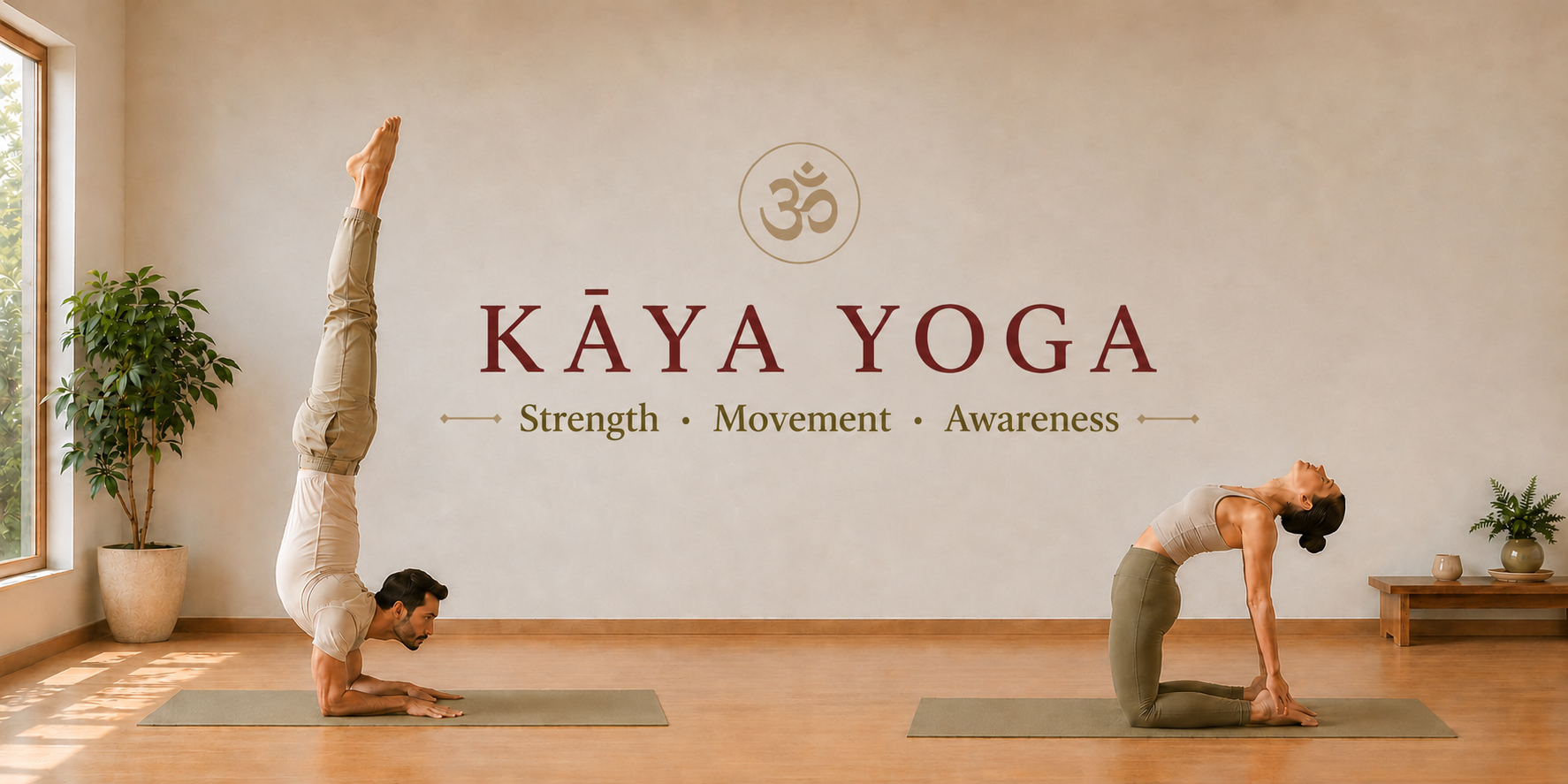
Kāya Yoga
Strength · Movement · Awareness
Strength · Movement · Awareness
Kāya Yoga is the body-oriented path of Trianga Yoga. Through āsana practice, functional anatomy, and intelligent alignment principles, it cultivates strength, mobility, stability, coordination, and embodied awareness. Rooted in the wisdom of traditional Hatha Yoga and informed by modern movement science, it offers a balanced and sustainable approach to practice.

Vision of Kāya Yoga
Kāya Yoga approaches the body not as an object to be perfected, but as a field of awareness through which yoga unfolds. Rather than pursuing externally defined ideals of flexibility or aesthetics, it encourages an intelligent dialogue with one’s own body. Every posture becomes an opportunity to cultivate stability, mobility, strength, sensitivity, and presence.
While rooted in the principles of traditional Hatha Yoga, Kāya Yoga recognises that contemporary practitioners benefit from an understanding of anatomy, biomechanics, and neuroscience. These disciplines do not replace traditional yoga; rather, they help illuminate how its practices may be approached safely, intelligently, and sustainably.
What Makes Kāya Yoga Different?
Kāya Yoga is distinguished by a number of principles that shape its philosophy, practice, and teaching. Together, these characteristics create a holistic and intelligent approach to āsana that is both rooted in tradition and informed by contemporary understanding.
- Holistic Practice: Every session works with the entire body through a balanced blend of standing, seated, balancing, twisting, forward bending, backbending, inversions, and restorative postures.
- Strength and Mobility Together: Equal emphasis is placed on developing strength, mobility, stability, endurance, and coordination rather than flexibility alone.
- Consistent yet Progressive Sequencing: Similar structural patterns encourage motor learning while variations in postures progressively expand capacity.
- Kinesiology-Informed Sequencing: Every posture, transition, and counterpose is thoughtfully sequenced according to principles of human movement, biomechanics, and motor control.
- Functional Alignment: Alignment principles draw on anatomy and biomechanics, respecting individual anatomical diversity rather than prescribing identical shapes for every practitioner.
- Smooth and Purposeful Transitions: Transitions become part of the practice rather than pauses between postures.
- Cultivation of the Inner Gaze: Attention is directed towards internal sensations, breath, and proprioception rather than external visual focus.
- Breath-Centred Practice: Breath rhythm guides movement and stillness instead of external counting.
- Longer Holds: Many postures are maintained long enough to cultivate strength, awareness, and nervous system adaptation.
- Yoga Nidrā: Each session concludes with guided Yogic relaxation, leaving the body and mind refreshed and rejuvenated.
These defining characteristics are not isolated ideas but interconnected aspects of a single, integrated approach. They are reflected in Kāya Yoga’s principles of functional alignment, its carefully structured sequence, its distinctive method of practice, and its comprehensive programme of study. Together, they create a system that is both rooted in tradition and informed by contemporary understanding, inviting practitioners to engage with yoga in a way that is intelligent, purposeful, and sustainable.
The Kāya Yoga Sequence
The Kāya Yoga Sequence is a carefully structured method of practice designed to develop the body in a balanced and progressive manner. Rather than arranging postures according to a fixed tradition or aesthetic preference, the sequence is informed by principles of functional anatomy, biomechanics, and neuroscience. Every āsana, transition, counterpose, and change in intensity serves a specific purpose, supporting efficient movement, healthy joint function, nervous system regulation, and long-term sustainability. While the overall structure remains familiar enough to cultivate motor learning and embodied confidence, individual postures and variations evolve over time, allowing practitioners to progressively expand their strength, mobility, stability, coordination, and awareness.
Functional Alignment in Kāya Yoga
A defining feature of Kāya Yoga is its emphasis on functional alignment. Rather than attempting to fit every practitioner into a single idealised form, the system recognises that natural variations in skeletal structure, body proportions, joint orientation, mobility, strength, age, and movement history influence how each individual experiences a posture. Instead of focusing solely on reproducing an external shape, Kāya Yoga seeks to understand the purpose and function of an āsana—what movements are being cultivated, what tissues are being engaged, and what effects are being produced. Drawing upon principles of anatomy and biomechanics, practitioners are guided towards the most stable, efficient, and sustainable expression of each posture for their own bodies. The result is a practice that optimises movement quality, distributes load intelligently, reduces unnecessary strain, and enables practitioners to move with greater awareness, safety, and confidence.
Practice
The practical component of Kāya Yoga integrates traditional āsana with principles of functional movement, breath awareness, and intelligent sequencing. Each session is designed to develop the body comprehensively while cultivating steadiness, awareness, and ease.
- Holistic blend of standing, seated, balancing, twisting, forward bending, backbending, inversions, arm balances, and restorative postures.
- Progressive development of strength, mobility, stability, endurance, coordination, and balance.
- Breath integrated throughout the practice to support movement, awareness, and nervous system regulation.
- Mindful transitions and functional movement patterns that enhance efficiency and reduce unnecessary strain.
- Progressive variations and modifications to accommodate different bodies and levels of experience.
Study
Understanding why we practise is as important as knowing how to practise. The study component of Kāya Yoga complements practical experience with a deeper exploration of anatomy, movement science, and yogic philosophy, enabling practitioners to approach their practice with greater clarity, intelligence, and purpose.
- Pañcha Kośa and the Scope of Āsana
Explore the five kośas (sheaths) and understand how āsana extends beyond the physical body to influence the breath, mind, intellect, and deeper dimensions of human experience. - Functional Anatomy & Neuroscience Informed Sequencing
Understand the anatomical, biomechanical, and neuroscientific principles that guide the structure of the Kāya Yoga Sequence, including posture selection, transitions, counterposes, and nervous system regulation. - Functional Alignment through Anatomy & Biomechanics
Learn to apply alignment principles based upon individual anatomy, movement mechanics, and functional purpose rather than fixed external forms, making the practice both safer and more effective. - The Nervous System and the Psychology of Āsanas
Discover how āsana influences the nervous system, attention, emotional states, and behaviour, deepening the understanding of yoga as a practice that integrates both body and mind.
Who is Kāya Yoga For?
Kāya Yoga is suitable for anyone who wishes to cultivate a deeper, more intelligent relationship with their body through the practice of yoga. Whether you are beginning your journey, refining an established practice, or teaching others, the emphasis on functional movement, anatomical understanding, and mindful practice offers a meaningful path for continued growth.
The practice follows a carefully structured and progressive approach that evolves with the practitioner’s experience and capacity. Rather than simply introducing more challenging postures, it systematically develops strength, mobility, stability, coordination, and awareness, allowing each stage of practice to build naturally upon the one before. This gradual progression enables practitioners to deepen their practice with confidence while respecting the unique needs and abilities of their own bodies.
Kāya Yoga Immersion and Workshop
If you would like to explore Kāya Yoga through guided practice and structured study, the Kāya Yoga Immersion program offers an opportunity to experience this approach in depth. Combining practical sessions with anatomy, alignment, and philosophy, it is designed for practitioners who wish to understand not only what to practise, but why.
Alongside the immersion, a one-day Kāya Yoga workshop offers an accessible way to explore the style and experience its approach to āsana.
Further details about the curriculum, schedule, and learning experience can be found on the Kāya Yoga Immersion and Kāya Yoga Workshop pages, respectively.